Showing posts with label Poetry Friday. Show all posts
Friday, April 12, 2013 | By: Brianna

Poetry Friday: If You Really Love a Writer

An update on NaPoWriMo: It's going well.  I haven't fallen behind yet, though I will this weekend because I'm going out of town to Girl Scout camp.  Because I'm awesome.  (And modest too.)  Anyway, the zodiac poems haven't actually been happening...but I'm hoping that something does happen just because of magic.  Maybe if I hold my breath they'll write themselves?

Today is Poetry Friday.  Today's poem is Megan Falley's "If You Really Love a Writer" (I used that video, but Blogger wasn't cooperating...) and I'm kinda upset that I didn't watch this sooner, because it makes me smile, and I had a tweet of one of her lines favorited AGES ago...but never dug deeper.  Until now.  Dun dun DUN!


Allow me to rant a little bit.  But let me start off by stating that I love notebooks.  Don't get me wrong, notebooks are awesome.  They're beautiful.  I mean, except for the spiral icky ones that are only ten cents that you use to take notes in class.  Those aren't too beautiful.  But I've noticed that as a writer, I do indeed tend to be gifted with notebooks.  I have a stack of five gorgeous notebooks sitting on my bookshelf waiting for me to fill up the first one I got so that they can be used.  It's only recently that I've been okay with using the beautiful ones.  I don't know what it is, but I suddenly get apprehensive about penning words between the pages of beautiful things.  Maybe it feels more permanent.  Maybe the notebook's expectations are high like it's saying, "I am a pretty notebook, therefore only pretty things may be written in me.  I scorn all your other ideas."  I don't know.  Point being, I completely agree with Megan Falley that a notebook has got to be the most intimidating and frightening gift someone could give an artist.

Pay attention to Falley's descriptions.  For example, "One is small and black like a funeral dress, its pages lined like the hands of a widow."  See what she did there?  Not only did she use a funeral dress to give the black notebook some better description than "dark as night," but she extended the death into the widow's hands.  AH!  It's so pretty, I don't know what to do with myself.  I think this works particularly well because it's concise and clever while also being unique.

Falley's treatment of time and the way she mentions significant life events is interesting to me because she never says "birthday" or "graduation."  Which would be boring.  Oh no, she uses "blown out birthday candle," and "turn of the tassel."  The listener knows what she's talking about because even if they haven't celebrated a birthday recently, the blowing out of candles is a tradition that's so cemented in our brains that we tend to think of birthdays without numbers being mentioned.  And turn of the tassel?  Everyone who's graduated from some level of school or seen a sibling or child graduate has seen the tassel travel from one side of a mortar board to the other.  So bringing in these common threads helps the listener empathize with where Falley's at even if they aren't themselves a writer.

"It's never a notebook we need."  This is interesting, because she goes on to say that if a writer gets struck by an idea (without using the word "struck" because that's cliche...), they're going to use whatever surface they have to jot it down, assuming they have a pen.  And if not, they're just going to repeat the line until it gets branded into their brain.  Which leads me to believe that the "notebook" that a writer needs is really themselves.  But the reason writers receive notebooks as gifts is because writers have a bad habit of failing as their own notebook.  Well, at least I do.

"If we have a story to tell, an idea carbonating past the brim of us..."  Argh.  I can't even begin to express how much I love this image.  Pop needs to be in more poetry just because of how lively and delicious the imagery is.

Falley's list of gifts it would be better to give a writer if you really love her make me smile.  The coffee table, the gravestone, the eviction notice, and the awful.  Particularly the awful.  Because honestly, a writer's got the best notebook they can ever hope to have, and if they don't have the gifted notebook with them anyway...they're just going to use whatever.  What a writer really needs is something to write about.

PROMPTS:
1.  Write about a gift.  Was it a good gift?  Was it the worst gift you've ever received in your life?  Was it a re-gifted gift that you weren't supposed to know about?  What about a white elephant/dirty Santa?
2.  Ideas are often described as lightning.  A flash of brilliance, and then gone.  But Falley uses soda pop as an image for a story/idea.  Come up with a unique image for an idea that doesn't use lightning or being "struck" by something.
3.  If you really love a writer, what would you give her?
4.  Notice Falley's descriptions of life events.  Take a page out of her notebook (ha, if she's using one) and describe a life event in one line that's pure image.  Let someone else read it and tell you what they think it is.
5.  Take a color.  Describe an object of that color.  Think funeral dress and widow's hands.  How can you extend the description into something neat like that?

"If you really love a writer, bury her in all your awful and watch as she scrawls her way out."
- Megan Falley, "If You Really Love a Writer"
Friday, April 5, 2013 | By: Brianna

Poetry Friday: Hangover Psalm

Today is Poetry Friday during National Poetry Month.  That worked out pretty well, didn't it?  Since I'm participating in NaPoWriMo, I occasionally visit their site and learn things by reading their posts, and I found this blog that's participating in the month's activities by posting poetry by poets (go figure, right?) and then getting recommendations from those poets for further reading.  This is an idea that I love.  So today's poem comes from there.  This is "Hangover Psalm" by Austin Tremblay.


Don't you love flattering thumbnails?  Incidentally, so do I.

Anyway, I really enjoyed this poem because I'm not particularly religious.  I'm not sure that sentence makes sense on its own, so let me explain.  I like the idea of tradition, but I also like stealing ideas and traditions and turning them on their heads.  Because it's fun.  And it makes me feel clever.

This poem feels like a prayer.  (Gee, maybe because it says "psalm" in the title, Brianna)  It has the rhythm and the feeling of a traditional prayer, but it takes that idea and puts its own spin on it.  Beginning with "darling" feels like the beginning of a letter or the equivalent of a "Hey God, sup..."  (And this is when I lose all readers who are super traditional and very formal about their religion.)  When I started reading this the first time, "give  us this day" came up, and my brain immediately filled in "our daily bread, and forgive us our trespasses."  I think this is a clever move of Tremblay's to put that line break there because the people like me will fill in the rest subconsciously, but be surprised in the next line, or the people not like me will interpret it as a request to be given the day, which sounds wildly romantic now that I think of it.  So pretty.

Anyway, I feel like I'm rambling, am I rambling?

There's a lot of church-like imagery going on in here, but it's handled in such a way that it's not overbearingly religious.  Which is awesome.  We've got the collection plate, ash, eulogizing, and shrift.  All really pretty words, except for "collection plate," but you know, those exist in churches.

Favorite lines because of the sound and the beauty of the image:
"We'll call our hearts linen,
though they are denim."

PROMPTS:
1.  Write a poem in the form of a prayer.  You know you want to...
2.  Write about a hangover.  And relate it to something totally unlike a hangover.  Perhaps going to church.
3.  What does Tremblay mean when he says "I can believe this morning/is a church"?
4.  Write in a "liquored dialect."  What does it sound like?  How is it different from a non-liquored dialect?
5.  Eulogize yesterday evening.  What was good about it?  Who is yesterday evening survived by?

"We will crawl through our own 
mouths for water, mispronounce 
everything in a liquored dialect, 
eulogizing yesterday evening."
- Austen Tremblay, "Hangover Psalm"
Friday, March 29, 2013 | By: Brianna

Poetry Friday: Preludes

I forgot it was Poetry Friday.  I almost didn't write about a poem, but luckily I remembered in the nick of time!  Huzzah!

So today I read T.S. Eliot's "Preludes."  I remember reading bits and pieces of this poem in my British literature class, junior year of high school.  This was one of the first poems that helped me decide that poetry might be cool to read.  It helped that there are some lines in here that show up in "Memory" from "CATS," and there was a time when I was in that musical...I don't really want to talk about it, it involved spandex and a painted wig.

And my brain is fried.  Hooray!

I promise that next week I won't be so horrible with Poetry Friday.

~~~~~~~~~~~~~~~~~~~~~~~~~~~~

Now is about the time of the month when I talk about my plans for the upcoming month of Poem-A-Day.  April's actually National Poetry Month and also National Poetry Writing Month, so hopefully that means that people out there in the world are taking part in some sort of poetry writing/reading shenanigans during the upcoming month.  For myself, I'm setting myself the challenge to write a poem about each sign of the zodiac. I'm not really sure how I'm going to time them or how I'm going to set them up, or even if I'm going to write them all in similar styles, so we'll see how that goes.  I'm also playing with the idea of posting this month's poems here so I can formally take part in the National Poetry Writing Month things, but that didn't work out too well last year, so I'm a little hesitant.  Plus that would throw off my whole "putting poems in an envelope and not reading them till the end of the month" routine.

"I am moved by fancies that are curled
Around these images, and cling:
The notion of some infinitely gentle
Infinitely suffering thing."
- T.S. Eliot, "Preludes"
Friday, March 22, 2013 | By: Brianna

Poetry Friday: More Lies

Today I read Karin Gottshall's "More Lies," which is a really beautiful poem, and I enjoyed reading it.


This is where I have every intention of writing about this poem.

PROMPTS:
1.  Write about people talking about "small things."
2.  Do you ever lie when someone asks "where you're headed"?
3.  Ever wished you had a sister or a brother?  Write about what it would be like to have grown up with a brother or sister that you don't have right now.
4.  What kind of relationship would two people have if they only ever met in cafes?
5.  Write a poem about meeting someone in a cafe.  Do it!

"Sometimes I say I'm going to meet my sister at the cafe--
even though I have no sister--just because it's such 
a beautiful thing to say."
- Karin Gottshall, "More Lies"
Friday, February 22, 2013 | By: Brianna

Hats Off!

Q:  Are you a hat person?

A:  Yes.  Absolutely.  My very first hat was a wool maroon beret that I got when I was 10.  I really wanted to learn how to speak French, and Santa Claus stuffed this topper into my Christmas stocking.  I was thrilled, and had no idea how to wear it even though I had asked for it.  So I experimented with jaunty tilts and wore it to elementary school where the baseball cap wearers who were asked to shed their hats asked my teacher why she wasn't asking me to take off my beret.

In 8th grade I played the Cat in the Hat in a play for my drama class.  Hat.

I'm not sure when abouts, but I managed to acquire an Indiana Jones hat from Disney Land somewhere in here around the same time that I got a black pinstriped fedora, adding two hats to my collection.

In my junior year of high school, I got a hat simply because I was playing Kelsie, a hat wearing piano player, in High School Musical.  That's really a great hat, it has an itty bitty pocket that I keep a shiny penny in...because I'm a dork.

I have a hat that I knit that I wear when I haven't showered and my hair looks gross so, surprise! to all the people who think I look cute on those days!

While I was at Disney, I also wore this hat.  I mean, I wore my costume hats too, but this was my fun hat.
And my Stitch wore a Nala as a hat...
The most recent hat that I've worn though has been a mortar board.  It's my personal opinion that these hats look dumb and no one looks good in them.  On my graduation day, mine kept slipping backwards because the hair pins decided they didn't want to do their job.  Needless to say they were fired after the event.  Anyway, mortar boards.  I'm not sure what they're supposed to look like or what the tradition is, but suddenly it feels very important for me to consult Wikipedia to find out.  [this is when Brianna went to consult Wikipedia about the mortar board]  Because everything on the Internet is true.  Well then.  It seems that the mortar board was adapted from hats that the clergy wore.  And there are so many variations on how schools in the U.S. use them, it makes my head spin a little.  Oh, and whatever you do, don't throw them...you'll hurt someone because they're like ninja stars...


Isn't that a lovely thumnail?  Enjoy "Exchanging Hats" by Elizabeth Bishop.

"Some hats can only be worn if you're willing to be jaunty, to set them at an angle and to walk beneath them with a spring in your stride as if you're only a step away from dancing.  They demand a lot of you."
- Neil Gaiman, Anansi Boys
Friday, February 15, 2013 | By: Brianna

Poetry Friday: Tooth Brush to the Bicycle Tire

In the spirit of the Valentine's Day season, I thought I would write about a love poem.  And I looked through the other poems that I looked at for Poetry Friday and realized, "Hey, I've done a lot of love poetry.  Is this a coincidence...?"  Probably not.  And then when I typed that sentence out and figured I should double check that I've indeed done "a lot" of love poetry, I realized that it was really just the last two poems that I wrote about that were love poems.  Now I feel dumb for making that wild generalization about myself.  I should be offended, but it would really suck if I got angry at myself at this point.

So here we have a poem by Sarah Kay, "Tooth Brush to the Bicycle Tire."


First off, it must be said that I think Sarah Kay and this poem are adorable.  I love watching videos of her performing because she never uses superfluous hand motions, and when she does use hand motions it looks like she's dancing.  Basically I think she's super graceful and I love her voice.  Not really something I can comment about with regards to the actual poem...but yeah.

Okay, I love this concept.  The idea of having inanimate objects speaking to each other is a beautiful one because we're surrounded by so much stuff, why not use it in our art?  It reminds me of Pablo Neruda's Odes to Common Things which I still haven't read all the way through, but "Ode to My Socks" sticks out.  I feel like we definitely don't appreciate the objects that we use daily, so giving them a voice or thanking them is something that I can appreciate.

"They said that you would tread all over me...that you were full of hot air...that it would be a vicious cycle..." Alright, so there are some puns here.  I love the puns.  So much love for the puns.  This sounds like typical advice that someone would get when it comes to loving someone from a "different world," and I think when this is contrasted with the language the tooth brush actually uses to express its love, it makes the declaration more meaningful.  We've got the "they" telling the toothbrush all these things, things that sound like they would be cliche but because it's about a bicycle tire...they're accidentally punning.  And the tooth brush seems to see the ridiculousness of it, and just nods, smiles, and goes on its merry way loving the bicycle tire.

There's a lot to be said about love poetry, and it can very easily slip into the realm of the cliche because there's just so much of it.  But I think that this poem with the tooth brush seeing "rough edges" and fitting "into any place you'll let me" is both sweet and true of loving someone.  Because everyone knows love is about seeing the whole picture and loving the flaws.

Love this poem, love the performance, love, love, love.

But I was really close to doing today's poem on Taylor Mali's How Falling in Love Is Like Owning a Dog.

PROMPTS:
1.  Make this concept your own.  Write your own love letter from one inanimate object to another.  How does the Toaster feel about the Lawn Mower?  And what about the Exercise Ball to the Dining Room Chair?  Is there a secret love triangle between the Whisk, the Waffle Iron, and the Lamp Shade?  Hm...
2.  So what's the bicycle tire's take on all this?  Does it return the tooth brush's love or is it stuck in a pair?
3.  Bring on the puns on cliched love advice.  It's gotta be there somewhere.
4.  What "places" do we fit in for the ones we love?
5.  What is it that "they" always say?  Do we take their advice?

"If loving you means getting dirty,
bring on the grime!"
- Sarah Kay, 'Tooth Brush to the Bicycle Tire'
Friday, October 26, 2012 | By: Brianna

Poetry Friday -- Love

This morning, when I woke up and thought about writing a blog post, I realized: hey, it's Friday!  Poetry Friday!  Then I didn't know what poem to write about.  I thought I might cheat and write about how (just like every year around this time of October) I'm considering participating in National Novel Writing Month.  I have yet to actually commit to doing it, well, let's be honest, I'd like to, but it's more a matter of committing to an idea than anything else.  Anyway...

Novels aren't the point, because today's about poetry.

Today I read Pablo Neruda's "Love," which I'm also going to type here because it took me an eternity to find it when I wanted to read it originally.  It makes me really want to be best friends with Pablo Neruda, steal his brain, and kiss him on the mouth.  Maybe not in that order though.

Love -- Pablo Neruda

So many days, oh so many days
seeing you so tangible and so close
how do I pay, with what do I pay?

The bloodthirsty spring
has awakened in the woods.
The foxes start from their earths,
the serpents drink the dew,
and I go with you in the leaves
between the pines and the silence,
asking myself how and when
I will have to pay for my luck.

Of everything I have seen,
it's you I want to go on seeing:
of everything I've touched,
it's your flesh I want to go on touching.
I love your orange laughter.
I am moved by the sight of you sleeping.

What am I to do, love, loved one?
I don't know how others love
or how people loved in the past.
I live, watching you, loving you.
Being in love is my nature.

You please me more each afternoon.

Where is she?  I keep on asking
if your eyes disappear.
How long she's taking!  I think, and I'm hurt.
I feel poor, foolish and sad,
and you arrive and you are lightning
glancing off the peach trees.

That's why I love you and yet not why.
There are so many reasons, and yet so few,
for love has to be so,
involving and general,
particular and terrifying,
joyful and grieving,
flowering like the stars,
and measureless as a kiss.

So I'm a sap.  Anyone who knows me knows that I am a complete and total sap, and they're either okay with it or they ignore me when I go into "sap mode."  I adore this poem.  I found quotes from it when I was browsing around Tumblr trying to decide if I want to get a Tumblr.  Then there was a gigantic Google search of epicness during which I found a bunch of other Neruda poems, none of them the ones that I wanted until I finally stumbled upon this one.  So I printed it out and it now lives on my bulletin board.  Basically it's awesome.

Anyway...I really love the third stanza.  The third stanza is the one that caught my eye originally and made me want to read the entire poem.  I love it.  Like a lot.  It's just about as good as chocolate covered strawberries and cuddly kisses.  It's so simple, and yet it's so swooningly romantic that I want to shake Pablo Neruda's hand and congratulate him for writing something so beautiful.  I don't know what "orange laughter" is, but I imagine it being something bright and delightful and sunshiney, and that makes me happy.

I like the idea that this poem takes on something that is so easily cliched because it's written about so much, and makes it new and fresh.  Sure, there are probably a ton of poems about how the speaker doesn't think they deserve the one who loves them, but this poem ropes in the element of luck and the consternation that the speaker will have to pay for having been so lucky in love.  This ups the stakes and makes things not so much about the self-deprecation of the speaker but more so about the elevation of the loved.

I have never heard spring described as "bloodthirsty," and I'm not quite certain how I feel about it.  But I am inclined to think that it has to do with the spring being most associated with love and "mating season" that it heats the blood, as it were.  These images of nature in the second stanza make me believe that the speaker's love for the subject is as natural as breathing.

"Lightning glancing off the peach trees."  Can we talk about how beautiful that is?  Sure, it's destructive in that lightning striking just about anything fries the "anything," but peach trees make me think of scent and fruit and delicious things and lightning is dangerous, but combined with peaches, it makes it all worthwhile.  Goodness gracious.  And I'm not sure how stars "flower," but yes.  So much yes.

PROMPTS:
1.  What is orange laughter?  Can you write something that either explains what this is or explores the idea of many-colored laughters?
2.  I dare you to write an un-cliche love poem.
3.  Write a poem in which the speaker self-deprecates in order to talk about their love.  Then find a way to twist that self-deprecation into an elevation of the love.
4.  Create an image of dangerous beauty.  What does it feel like, and what kind of emotions does it inspire in the speaker?
5.  Write about the bloodthirsty spring.  What's up with that?

"I love your orange laughter."
- Pablo Neruda, 'Love'
Friday, October 19, 2012 | By: Brianna

Poetry Friday -- Kiss

Once upon a time, I read a poem by Gabriel Gadfly.  Once upon another time, I thought that I should post something about Poetry Friday, and StumbleUpon provided me with another Gabriel Gadfly, this one titled "Kiss."

This is an example of a poem that uses the same word over and over.  Though I'm sometimes of the opinion that if you say a word over and over again that it starts to lose meaning because all it becomes is a sound, I believe that this poem uses "kiss" effectively without allowing it to lose its meaning.  In fact, I would argue that this poem opens up far more definitions and interpretations of the word "kiss" and what it actually means to kiss someone.  And the experience of communicating through an intimacy like that.

The line "you are the water and the jug" reminded me quite a bit of Billy Collins' "Litany" mostly because of the way that the line is set up in the "you are the ________ and the ________" format.  I'm wondering if that was a purposeful similarity.  Then again, rather than continuing to list the things that the "you" is or is not, Gadfly transforms it into a metaphor with his "thirst and thirst."  Going along with that, there's a good bit of water imagery and words that evoke the idea of water: spill, thirst, moist, etc.

This poem interested me in that it makes simple rhymes, but they're not distracting.  I usually find that amateur poets who try to write rhyming poetry come out sounding like Dr. Seuss.  And maybe that's just my prejudice, or I'm weird, but yeah.  That.  But Gadfly juggles his simple rhymes with a grace that keeps them from being distracting.

And this is when I lose steam because my brain is mush.

PROMPTS:
1.  Experiment with rhyme without creating a Dr. Seuss poem.  Good luck!
2.  Come up with a simple metaphor that you can extend through a couple lines.  Kinda like the "water and the jug," and the "smoke and the salt."
3.  Write about a kiss.  Or a series of kisses.

"But first I will kiss her and spill
Herds of sweet words
Over the hills of our mouths,
Beautiful words..."
- Gabriel Gadfly, "Kiss"
Friday, September 7, 2012 | By: Brianna

Poetry Friday -- Snow White's Acne

This morning, I woke up, read a couple blog posts by friends, and then realized that I also have a blog and could probably post something.  After waffling about what I could possibly write about, I realized that it's Friday.  [and don't you dare start singing that Rebecca Black song...oh wait, it's already in my head]  And Friday means...

Poetry Friday!!!

Since I haven't done a Poetry Friday in approximately forever, it's going to be a bit interesting to see how I can get back into it.  I'd like to get back to blogging daily as well, but you know...some things aren't going to happen, especially when I have this really pretty journal that I can hand write in.  And you know how much I like hand writing things.  [I'll give you a hint, I actually prefer it...]

So today I read a poem by Denise Duhamel, mostly because I forgot to read something by her when she came to visit at my university and also because I was looking for something by her that I was really interested in.  Duhamel writes a lot of modern stuff including (but not limited to) a number of poems about Barbie, chronicled in her book Kinky.  Though I haven't read all of Kinky, I read the bits that were found in her collections Queen for a Day.  But today isn't about Barbie.  Today's about Snow White, which I thought was rather fitting.  Today I read "Snow White's Acne" which sounds like an off-putting title.  Although not really for me because I love fairy tale poems, and I especially enjoy fairy tale poems that take the fairy tales and twist them up for the reader so the story's a little less pure than you originally thought it was.  Because let's face it, some of these princesses really need to be taken down a peg.  Or four.

First off let's talk a little bit about the title.  It has the word "acne" in it.  How many people actually find the word "acne" appealing?  I can tell you right now that there isn't a very large number of people who enjoy the word "acne" or the feelings that the word "acne" inspires in their pores.  Although my pores are currently rejoicing at the mere mention of acne because they're creating enough to rival Snow White's adolescence in this poem.  Anyway, when you think of Snow White, you immediately finish up her title with "and the seven dwarfs," so you're set up with one set of expectations, yet this title gives you a different answer.  Acne.  What could be less dwarf-like than acne?  Well, you could probably argue that acne is kinda like dwarfs in some ways, but I'm not going to go there right now.  A twist of expectations in this way makes things interesting.

Now about those comparisons.  And/or descriptions.  "Dried strawberry juice"..."like a tapeworm curled up"..."multiplying like pins in a pin cushion."  And on and on.  They're very vivid descriptions that we've got here, and they all seem very concrete, comparing or using descriptions that are rooted in real world things like juice or tapeworms or pins.  I think this makes the descriptions of the acne even more grotesque, and that definitely brings Snow White down a couple notches.

And at this point I have lost steam with my poetry "analysis," so I'm going to stop for now...if I think of other things...I'll come back.  Yeah...

Another good Snow White poem is Anne Sexton's "Snow White and the Seven Dwarfs."

"The Queen remained the fairest in the land.
It was hard on Snow, having such a glamorous mom.
She rebelled by wearing torn shawls and baggy gowns."
- Denise Duhamel, 'Snow White's Acne'
Friday, June 8, 2012 | By: Brianna

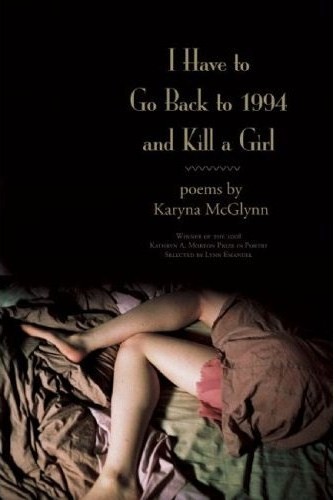
Poetry Friday -- I Have to Go Back to 1994 and Kill a Girl

It's been a while, but it's about time that I bring back Poetry Friday and some modicum of structure to this lackadaisical project that is this blog.

Because I'm out of school, that means my interaction with people of a poetical bent is limited to Facebook and StumbleUpon accidental encounters, sprinkled with the occasional text from people who feel like being poetic. This means that I'm at home and my family don't really do poetry like I do.  If at all.  So in an attempt to get myself back into a poetic mindset, I've been looking for books of poetry at my local library.  After reading Mary Jo Bang's Bride of E, I picked up Karyna McGlynn's I Have to Go Back to 1994 and Kill a Girl.

Thank you, Google!
This title was suggested to me by my Stand Up Poetry professor when I asked him if there were other things outside of our anthology that I should be reading.  Because of the recommend-er, I figured that the subject matter would be humorous.  Judging the book by its cover, I realized that I was mistaken.

(Brianna enters her local library and retrieves her poetry books from the inter-library loan shelves.  On top of her pile is a book of poetry by Karyna McGlynn.  She slides her stack of books onto the check-out counter.)

Brianna: (rain-soaked but cheery, carrying a large duffel bag) I'd like to check out these books, please!

(Librarian, who knows Brianna, looks at the cover and the title of the book on top of her stack and gives her a look that says something along the lines of, "Trying to tell me something, Brianna?  Is this a confession?")


Brianna: (realizing what the look must be about) Oh!  I've been writing a poem a day since September, so I needed more poetry to read.

Librarian: (raises his eyebrows) Good for you, Brianna.  But you know copying poems from here doesn't count...

(Brianna chuckles nervously and stuffs the books in her duffel, leaving the library hastily.)

I have no intention of copying poems out of this book, but I had hoped I could use it as some sort of inspiration.  On a whole, this book is nothing that I had expected.  Significantly darker and more sexually charged than I would have expected, Kill a Girl is a fascinating read.

The way McGlynn formats the majority of her poems is really interesting.  A couple poems (for example, "I Want to Introduce Myself, Not Quite Human," "The Thing in the Middle Which Has No Corner," and "Somebody Shook Me: Wake Up It's Raining Oil") use multiple columns, most commonly two or three.  While I was reading, I wasn't quite certain if I should read straight across left to right or if I should be reading the left column and then the right column, so I tried it both ways, and I found out that most of the poems could work either way.  Granted, you get a different poem depending on which way you read it, but I thought the effect created an shakiness within the structure of the poem that was both thought-provoking and alluring.  In addition to her column structure, McGlynn also uses a sort of woven formatting that you can see in "The Poem with Its Teeth Caught In the Carpet."  Kind of like this:

1111111111111111
                     22222222222222
3333333333333                    3333333333333
                      4444444444444

So I wasn't sure if I should read the first line then the first half of the third line and go from top to bottom following each semi-column or if I should read the first line, the second line---you really don't need to know all of how I was thinking through this, but point being, I thought that the effect was really neat.

McGlynn's use of language is phenomenal.  I'm not sure how she does it, but she manages to paint images within short lines and jump to the next image almost immediately.  She doesn't shy away from words like "panties" or "crotch," but she owns them along with the sparse appearances of the word "fuck."  She is unapologetic and dark, but still you want to read on.  I was nervous that I was going to get all uncomfortable and not want to continue reading, but that wasn't the case at all.  Each one of McGlynn's poems is saturated in imagery, so much so that it would be safe to say that I would be able to go back to these poems and still find new things to think about.  Definitely a thought-provoking read.

PROMPTS:
1.  Play with line breaks.  See if you can create a "woven" or column poem that makes sense in multiple directions.
2.  Experiment with line length.  In "The Nursery with Half a Window Up Near the Ceiling," the lines alternate between longer lines and short lines.  What effect does this have on the poem and what can it create in one of your's?
3.  Many of McGlynn's poem titles lead into the actual poem.  Can one of your first lines be used as the title so you just start right in the poem right away?
4.  In "I Show Up Twelve Years Late For Curfew," the speaker's parents don't seem to recognize her, and in the last stanza she says, "This is my family, these people so inept at things like / memory and monopoly, I feel like a trickster god / hiding my funny-money under the board."  Can you create an extended metaphor based on a board game?  What simple things can people be inept at but still be forgiven?
5.  "I Want to Tell Her I Won't Need Calculus, I Want to Warn Her," doesn't have much to do with math.  What subjects are actually unneeded?  Would you warn someone?  How can you warn them without really warning them?  Or how can you use calculus to talk about something else worth warning someone about?

"why the animal stretched its neck is beyond me
it wasn't a black alpaca
it had eyes as Chinese stars but bigger
it had no chin or ears
it was peering at the sky and then at me"
- Karyna McGlynn, "In a Landscape the Color of Bleached Limes"
Sunday, March 11, 2012 | By: Brianna

Poetry Friday -- Vogon Poetry

So because I'm making up blog posts today because I was a slacker before and because I'm not really held accountable for the legitimacy of any of my blog posts, I'm going to write about Vogon poetry.

Today is Douglas Adams' birthday.  If he were alive today, he would have been 60 years old.  Douglas Adams is the author of the series that starts out with The Hitchhiker's Guide to the Galaxy.  Apparently it's called a trilogy even though it has five books because Douglas Adams was a wonderfully ridiculous man.  There's also a sixth book in the series written by Eoin Colfer (author of Artemis Fowl) fairly recently.


Fun fact: Douglas Adams wrote for Doctor Who.  Thereby further legitimizing my love for the British science fiction show.  (Even though Douglas Adams didn't write any of the episodes I've ever seen...)

Douglas Adams is one of the main reasons why I believe that the things I write might actually be considered popular one day.  If he can send a Chesterfield bouncing across an open field, then why can't I do whatever I want in my own writing?  Okay, maybe not whatever I want until I'm about as famous and well-known (because those are two different things, right?) as Douglas Adams.

So Vogon poetry.  According to The Hitchhiker's Guide to the Galaxy is the "third worst poetry in the Universe."  Listening to it read is something akin to torture.  Honestly, I think Vogon poetry is a little amusing, but it takes the form of nonsense verse.

I think there's something to be said about nonsense verse.  In some ways I feel like it can be used effectively when someone integrates nonsense with sensical things if only to give it some context.  I'm thinking of "Jabberwocky" and the idea that "the momeraths outgrabe" (I'm doing this from memory, so please don't punch me).  Also if there's a pleasing rhythm or sound to the nonsense verse, it's more likely to be appealing.  I get the distinct feeling that that's not the case with Vogon poetry, so I'm not holding my breath.

The description that the Guide gives it is (provided to me by Wikipedia):
"Vogon poetry is the third worst in the Universe. The second worst is that of the Azgoths of Kria. During a recitation by their Poet Master Grunthos the Flatulent, of his poem, Ode to a Small Lump of Green Putty I Found in My Armpit One Midsummer Morning, four of his audience members died of internal hemorrhaging, and the president of the Mid-Galactic Arts Nobbling Council, survived by gnawing one of his own legs off... The very worst poetry in the universe died along with its creator, Paula Nancy Millstone Jennings of Sussex... in the destruction of the planet Earth."

So Vogon poetry probably wouldn't be that bad if it had a rhyme, rhythm, or reason.  But because Vogons enjoy watching you squirm in pain and agony from hearing their verses...I find it difficult to believe that they would try to make their poetry enjoyable.

I found a couple Vogon related links that you might want to check out:
http://www.bbc.co.uk/cult/hitchhikers/vogonpoetry/lettergen.shtml (I wrote one of these, and the first adjective should not have been "cheery."  Oops!)
http://www.whippersnapperpress.com/events (I'm really jealous that they have a Vogon poetry slam.  If I lived in the UK...I would be so there.)

"A common mistake that people make when trying to design something completely foolproof is to underestimate the ingenuity of complete fools." 
- Douglas Adams

Excuses, Excuses

So I forgot to blog yesterday.
And the day before.
And the day before.
I think that at this point I should call it a failure because I missed three days out of my Lenten promise thingy to blog every day.  But at the same time, I feel like I should be given a little slack because I've been busy.  Sure, I'm always busy, but I'm talking about real fun busy.  I've been home.

Friday I was just so excited to go home that I spent the day reading a comic instead of packing (well, after I was done packing) and listening to Pandora.

Saturday, well, Saturday I spe---(this is when I realize that I only really missed Friday and Saturday, I didn't miss Thursday, aha!)---Saturday I spent downtown.  Doing lots of things.  Maybe I'll post pictures of the craziness that occurred that really wasn't that crazy, but might be interesting to see all the same.

Today...today I'd like to do things.  Preferably homeworky things so I don't have to worry about them for the rest of break, but I'm not sure I'll be able to revise an entire story in one day.  In theory, it can happen, but I'm not sure I want to stress myself out while I'm at home.  But what would be the fun of spring break if I wasn't stressed out, right?  So...we'll see what happens with that.  I might just end up reading about politics and religion in Shakespearean era England and then that short story I'm supposed to read for my fiction class, thereby leaving all the re-writing for later like the good procrastinator I am.

So I'll do a poetry analysis thing today to make up for Poetry Friday, and I'll do something to make up for yesterday and then I'll be on track.  And then I'll catch up on my Poem-A-Day Project.  Oops...apparently being home just throws everything off.  Weird.
Friday, March 2, 2012 | By: Brianna

Poetry Friday -- Little Red Riding Hood and the Wolf

This Wednesday there was a themed poetry slam at my school organized by our performance poetry group.  The theme this time came off of the list of ideas that I sent ages ago, and it turned out to be "fairy tales."  Which was perfect for me because I love fairy tales.  Almost more than life itself.  Unfortunately, due to unforeseen and stressful circumstances, I was unable to write my very own fairy tale poems so I could participate in the poetry slam.  So...I just read during the open mic and I read this lovely poem by Roald Dahl called "Little Red Riding Hood and the Wolf."  It's kinda awesome, which is why I chose to talk about it on this Poetry Friday.

Thank you, Google!
First of all, this poem rhymes.  Now I'm not usually a fan of rhyme unless 1) you are Dr. Seuss, 2) you're writing for children, 3) you're Moliere and this is Tartuffe OR 4) it's so well done that I don't even notice that it rhymed until after I'm done reading it.  Because Roald Dahl is neither Dr. Seuss nor Moliere, that leaves us at either writing for children or well done rhyme, both of which I believe this poem falls into.  Sure "Grandmamma" and "caviar" are more of a slant rhyme than a true rhyme, but the rest of the end rhymes help move the poem along.  The rhyme in this poem also goes hand in hand with the rhythm.  The rhythm is really a quite bouncy one which helps the poem move in a kind of sing-song fashion, which is fitting for the subject matter and the story that's being presented.  In fact, if this poem didn't use this type of rhyme or rhythm, it might sound odd or more foreboding, far less cheery.  Although foreboding would also be appropriate what with the talk of eating children, but that's beside the point...

Another thing that I noticed which I talked about last week in "Initiation" is the use of dialogue.  Dahl uses quotation marks and dialogue tags to signal when he's using dialogue, which is a tradition of fiction.  For instance, "And Wolfie said, 'May I come in?'"  Dialogue is absolutely essential in this poem in order to follow the "show, don't tell" rule and because of the traditional, "What great big ears you have, Grandma" that goes along with Red Riding Hood regardless of what version you're reading.  (Okay, so there are different versions, and maybe it's not exact, but we're not going there today.)  When reading this poem aloud, it's really easy to take on different voices for characters such as the wolf and Little Red because the dialogue tags alert the reader to who the speaker is going to be.  And who doesn't love a deep-voiced raspy wolf to chat with a high pitched and cheery Little Red?

This poem does a good job of riding the line of the traditional Red Riding Hood story before twisting it.  After Little Red makes all her usual observations, she says, "But Grandma, what a lovely great big furry coat you have on."  The wolf breaks the pretense of the poem by saying, "That's wrong!... / Have you forgot / To tell me what BIG TEETH I've got?"  This is particularly interesting to me because though the character doesn't explicitly acknowledge that he's a part of a story, he does acknowledge the original story by chiding Little Red for straying from the "script."  It's definitely one of the most fun things about this poem that the wolf corrects Little Red.  But Little Red strays so far from the script that she "whips a pistol from her knickers. / She aims it at the creature's head, / And bang bang bang, she shoots him dead."  And then we're left with a feisty Little Red in a wolfskin coat.  This departure from the original tale is plausible enough that the reader doesn't just throw the poem to the ground in disgust, and interesting enough that it retains the reader's attention and even earns the approval of the reader.  In short, what this poem does, it does very well.

PROMPTS:
1.  Write a rhyming spin-off of a traditional fairy tale.  Keep in mind rules of rhythm and rhyme, and try not to use lame rhymes if you can help it.  Think "Grandmamma" and "caviar"...
2.  Use some dialogue if you haven't already.  Signify it with italics or quotation marks, but probably not both.
3.  At the very end of this poem, the storyteller references himself (we're going with the masculine pronoun because of Dahl...) as "I" who ran into Little Red in the wood.  Write something in which the narrator appears in the action but as an observer or a commentator after the fact.
4.  Write about wolves.  Or what if the wolf in Little Red Riding Hood was actually...a bear?  Or a leopard?  What would happen then?
5.  Write this story from Granny's perspective.

"The small girl smiles.  One eyelid flickers.
She whips a pistol from her knickers.
She aims it at the creature's head,
And bang bang bang, she shoots him dead."
- Roald Dahl, "Little Red Riding Hood and the Wolf"
Friday, February 24, 2012 | By: Brianna

Poetry Friday -- Initiation

Today is Poetry Friday.  This week I remembered, and I was really excited because this meant that I got to read a poem and talk about it rather than studying for my Statistics exam that I'm going to have to take at 1 PM today.  We're excited about this procrastination because it'll give me time to forget that I literally just looked at the answer sheet for my study guide and if I try doing the practice problems, I'll probably remember what the answer looked like, and that's akin to cheating.  On the study guide.

Thank you, Google!
Anyway, I'm going to talk about Matt Guenette's "Initiation" from his book American Busboy, a book which everyone should read because it's fantastic.  You should be able to see my review of it on Goodreads somewhere because my Stand Up Poetry class read it for class and I really enjoyed it.  PLUS, Guenette came to campus just last week, and I thought I would do him homage by reading and talking about one of his poems if I could find it online, and luckily I did...because otherwise I wouldn't have known what to write about.

"Initiation" is a poem about initiating a new busboy into the culture of the restaurant in which he is about to work.  The manager sticks his hand in breading and then into the frialator (which Chrome says isn't a word) to scare the busboy into obedience.  The second half of the poem assures the reader that the manager treats the busboy more kindly in the following days but turns around and slaps all the readers on the face with the twist at the end.

When you first look at "Initiation," you're struck by the arrangement of the poem.  It's not all left-aligned and it's not centered to make it look more like a poem.  It looks like it's all over the place, but really there has to be a method to the madness.  I'm not going to say that I know what that method is, but there's gotta be a method.  Perhaps just as the manager in the poem is initiating the new busboy, this poem is meant to initiate the reader into the world of this poem or maybe Guenette's poetry as a whole.  Somehow it shows us what to expect from the poems to follow.

One feature of this poem that I thought was particularly interesting is the semi-repetition.  You can see it in "The manager sticking / his hand in the breading.  The manager / sticking his breaded hand..."  First off, the second line ends with "the manager," bringing the reader's attention back to the manager with that line break directly after the title.  This happens two more times throughout the poem.  But like I was saying about the repetition-ish.  I can't really say it's true repetition because we're not getting the same exact thing twice, but "sticking his hand in the breading" and then "sticking his breaded hand" turns around some of our expectations.  Sure, we know that once the manager's put his hand in the breading his hand's going to be "breaded," but the way this is executed dances in front of us and flaunts its cleverness.  It's just a couple rearranged words, but it still intrigues us.

We've also got some dialogue going on here, and it's italicized, which is nice because frequently quotation marks distract and just look weird.  But the dialogue flows along rather nicely.  The only times when we hear the manager speak are when he's talking to the busboy and messing with him because we've got "Don't mess with me" and "Well he's on the phone now asking for you."  Guenette could have added in "Oh yeah, do you remember blowing bubbles when you were a kid?" but he didn't.  I can see why, because if he had then the poem would probably have been too dialogue-heavy, and also we'd hear the manager setting up his own joke, and that would detract from the manager's messing with the busboy.

And then there's "blowing bubbles."  There's not much more to say about that only because when I finally "got it" during class discussion, I may have made a revelation "OH MY GOSH!" exclamation and applauded Guenette's cleverness.  So upset I didn't get that on the first reading.

PROMPTS:
1.  Write about a time when you were initiated into something.  A club, a class, a friend group.  Fictionalize the horror, but no hazing...
2.  Take a tip from Matt Guenette and end your poem with an innuendo.  Because you know you want to.
3.  How about using some of that repetition.  Switch some things up a bit so it looks and sounds new, but you know the truth...you're just using the same words in a creative new order.  (Beware: Avoid sounding like Yoda.)
4.  Experiment with line breaks and re-aligning your poem.  Maybe it'll look strange at first, but see if you can justify (haha) your madness.
5.  Integrate dialogue.  Sparingly.  For effect.
6.  Create a character like the manager.  Menacing yet well-meaning.  See if you can create this character and  emphasize the fear that his subordinates feel.  Have you ever worked with a manager like that?

The manager sticking
his hand in the breading.  The manager
sticking his breaded hand
in the frialator just long enough 
so when he pulls it out
a frequently nightmare-looking thing encrusted
in sudden crust emerges.
- Matt Guenette, "Initiation"
(I had to remove the formatting so it looked pretty here, sorry!)
Friday, January 6, 2012 | By: Brianna
Friday, December 23, 2011 | By: Brianna

Poetry Friday -- A Spiral Notebook


Today's Friday, which means...Brianna's reading and analyzing poetry!  Excuse the video quality, or the lack of alignment of video and audio...I blame Youtube.

This Friday I read a poem by Ted Kooser called "A Spiral Notebook" which I found in Good Poems for Hard Times.  If truth be told, the reason I picked this book up was because the spine was yellow and it said "Good Poems," I didn't see the "hard times" until after I got it from the library.  Sometimes I play into blonde stereotypes...

The biggest thing that I noticed in this poem is essentially a gigantic description.  It opens on a simile comparing the spiral wire roll to a "porpoise / in and out of the calm blue sea / of the cover..." which is a good integration of the animal comparison and the physical attributes of the notebook.  It seems to me that the poem could have been taken in the direction of going crazy with the porpoise image or stayed along the lines (ha ha, notebook, lines...) of physical descriptions, leading me to believe that the speaker leaned toward the latter.  The wire is also compared to a "sleeper / twisting in and out of his dreams" with another simile.  So lots of simile going on here.

The poem also discusses the function of the notebook.  "...it could hold a record of dreams / if you wanted to buy it for that, / though it seems to be meant for / more serious work," perhaps recording serious thoughts.  Here the speaker seems to directly address the reader by acknowledging a "you" which carries through the end of the poem.

The announcement of the "5 SUBJECT NOTEBOOK" is in the center of the poem in all capital letters, drawing attention to itself.  This poem is also made up of only two sentences, and this line ends the first sentence.  This is where the poem turns, talking more about the subject of growing old and (consequently) growing up.  The comparisons become a little more abstract in that they're broader, comparing the uses of notebooks by the young and uses by the old.  Or older.  It touches on the anxiety a person might feel while clutching a single subject notebook, alluding to the idea that the shopper would have chosen and committed to a single subject.  All the while "passing / your fingers over its surfaces / as if it were some kind of wonder."

So "analysis" was optimistic here.  I'm feeling rusty.  I'm going to blame Winter Break.  We'll go with that.

PROMPTS:
1. Think about the possible uses for an object or a notebook.  Enumerate them poetically.
2. How detailed a description can you write of one simple thing?  Can you romanticize a clothespin?  A bookmark?
3. Write about something that children use and how adults use or view it differently.  I'm talking about how do kids use red pens differently than adults?  Or highlighters?
4. What would you stand in a drugstore and buy?  Talk about a Walgreens/CVS shopping trip.

"...but instead to stand in a drugstore
and hang on to one subject
a little too long, like this notebook
you weigh in your hands..."
- Ted Kooser in "A Spiral Notebook"
Friday, September 16, 2011 | By: Brianna

Poetry Friday -- I Need to Be More French. Or Japanese.


Today is Friday, which means that Brianna should be reading and "analyzing" poetry.  So here we go.

This week I read Beth Ann Fennelly's "I Need to Be More French.  Or Japanese."  I read it aloud on YouTube, but you can feel free to read the poem all by yourself on the link that I'm attaching to the title of the poem riiiight...now.

First off, the title of the poem flows pretty nicely into the actual text of the poem, and I respect that.  I can never get my titles to do things like that, but I think it adds a nice effect to the poem.

One of the big themes/thoughts of this poem is the idea that the speaker isn't subtle.  She (I'm going to call the speaker a "she" for now because pronouns are fun) prefers California win "its big sugar, big fruit rolling down [her] tongue" (53) and she says that she wears a lot of yellow, thereby "pledg[ing] to wear more gray, less yellow" (53).  The tension in this poem lies in the idea that the French and the Japanese are more subtle, more refined, and less boisterous than the speaker.  So this idea that the speaker needs to be something that she's not is interesting.

The imagery is centered on French and Japanese...things.  I don't know how else to describe it.  The speaker uses a quote from Cezanne to illustrate that people sound smarter in French, and "The Japanese prefer the crescent moon to the full, / prefer the rose before it blooms" (53) which is an interesting image because it sounds as if the Japanese prize potential rather than the finished product.

The first half of the poem focuses on this clash amongst French, Japanese and the speaker's tendencies, all the while illustrating how not French or Japanese the speaker is.  The French designer who makes an appearance in the poem disdains the speaker for this "not Frenchness," so perhaps the speaker has been confronted with this "not-ness" before?

The turn (which one of my poetry professors would be SO excited that I'm pointing out) takes place (I think) around "OK: I didn't really.  But so what..." (53).  At this point in the poem, the speaker is embracing her true self.  She's owning her qualities.  But at the same time, she's still comparing herself to the French and Japanese, which makes things interesting.  She writes "If I were Japanese I'd write a tone poem / about magnolias in March, each bud long as a pencil...I'd end the poem before anything / bloomed..." (53-54) because the image that the speaker paints for the Japanese is all about potential.  Before anything bloomed.  Perhaps the speaker can consider herself one of those magnolia buds?  In contrast, "If I were French, I'd capture post-peak, in July, / the petals floppy, creased brown with age..." (54), making the French sound like the "day after" a party.  A really good party.  But the images of both beginning (from the Japanese) and end (from the French) come together as the "red-tipped filaments" all over the lawn signal an end for the French, but a beginning for the Japanese because they look like matchsticks.  "..and it's matchsticks, we all know, that start the fire" (54).

PROMPTS:
1.  Fennelly uses a lot of landmarks/geography in this poem.  We've got the temples of Kyoto, the Pont Neuf, and Wrigley Field.  Write something that integrates landmarks.  Subtly, of course.
2.  Are there objects or images that can symbolize both a beginning and an end just the way they are?  Write about it.
3.  Find a way to integrate dialogue into your poem and give those people some character, like the French designer in this poem.
4.  End your poem with spent firecrackers, since Fennelly didn't, but said that she would.
5.  "I hereby pledge to be reserved."  What kind of character would make such a pledge?

"I have stood on the Pont Neuf, and my eyes,
they drank it in, but my taste buds
shuffled along in the beer line at Wrigley Field."
- Beth Ann Fennelly in "I Need to Be More French.  Or Japanese."
Friday, September 2, 2011 | By: Brianna

Poetry Friday -- Pole Dancer

This Poetry Friday I’m going to be looking at Andrea Gibson’s “Pole Dancer.”  Mostly because it was suggested that I look up Andrea Gibson’s poetry, and also because I feel like listening to poems rather than reading them today.  Strangely enough, after listening to a couple of Gibson’s poems, I realized that I had heard them before.  Which was silly because I’ve never seen Andrea Gibson perform, I’m pretty sure I would remember.  And then I realized that it’s because some of her poems are in this book of slam poetry I have called Junkyard Ghost Revival.  So it’s the best of both worlds today because I get to listen to “Pole Dancer” and also refer to it in this book.  Occasionally I’m clever like that.


First thing I’d like to compliment about this poem is the voice.  Andrea Gibson has the unique ability to combine contemporary imagery with meaningful sentiment and humor.  It’s truly amazing how Gibson manages to say so much and mean even more in this poem.

I LOVE the stanza about crocheting a scarf and pinning a note to it, mostly because of Andrea’s spot on delivery.  You could not add more humor to that collection of lines if you tried.

Her use of story is interesting because she tells little snippets rather than plowing right through a single storyline.  She explains about crocheting the scarf, counting freckles, and now that I look at it, those are the only two snapshots that I can find, but both focus on the body in a truly romantic way.  Plus both are laden with Gibson’s spectacular imagery.

Gibson also uses triples to her advantage.  Not always for comedic effect, but most of the time to emphasize or round out imagery that would be strange if there was only one part to them.  The one that sticks out most to me is the triple that includes comparisons to “popcorn at a drive-in movie,” “Batman and Robin,” and “Pac man in the eighties.”  I especially appreciate the pop culture references, and how can I say no to popcorn?  So great.

Closer to the end, she says “Lover, this is not just another poem” which I love because 1) it’s borderline metafictional, 2) it’s direct address, and 3) because she uses the word “lover” with such power, it hits me like a block of cement to the sternum.  This is just one example of how Gibson uses words.  Yeah, that’s right, I made that observation.  Gibson is a poet who doesn’t just build up her poem, she makes every single word count.  EVERY word in this poem is imbued with the strength of the poet and enhances the overall poem.  Just wow.

Favorite image that I just found again:  “I have been painting the night sky upon the inside of doorframes / so only moonshine will fall on your head in the earthquake.”  AH!  Okay, not only am I a sucker for imagery that takes the night sky into consideration, but the night sky has such a danger of turning cliché, but by grounding the image in the doorframe, Gibson allows the night sky to become something more solid, something that’s within reach.  Plus I love an image that makes me think “Wow, that’s really cool” and this is one of those.  I can just imagine Gibson painting little pinprick stars around every side of the doorframe and then sending her lover to stand there in an earthquake.  And the house that holds it has fallen, but the doorframe stays standing, beaming moonshine.  AH, so good.

I also enjoy the multiple uses of the word “break,” but that’s just a sidenote.

Finally, wow, ending image/comment.  Just wow.  “…how they never speak guardrail, / how they only say fall.”  Just wow.  I’m leaving it there.

PROMPTS:
1. Use the night sky.  Don’t let it be cliché.  If you’re going to use a flowery description of stars and romanticize about how far the cosmos is from your fingertips, please skip this prompt.
2. Write a pop culture triple.  Because you know you want to.
3. Tell a story in snapshots.  Or tell snippets of a life.
4. Write a poem.  Go back and cut all superfluous words.  Use words sparingly and inject them with your own unique power.
5. Write a poem to be performed.  And go out and do it!


--------------------------------------------------------------------


On a note slightly (okay, maybe very) related to poetry, I was walking home from a meeting with my friend...


Katie: Have you heard about that challenge where you write a poem a day for a month?
Brianna: Yeah, that sounds crazy.
Katie: Yeah.
Brianna: It's September 1st...wanna do it?
Katie: Yeah!  We can exchange poems and then we'll have mail every day!
(and this is the point in this script where if this were a movie we would jump into the air and high five)


I'm REALLY excited about this project because I've been feeling really poetic lately, and if I commit to writing a poem every day, then maybe I'll actually get things written.  I've already spent my last couple of business classes scribbling out lines of poetry, and though it's not a habit I should be encouraging in myself, it feels good to write some poetry for once.  And of course I'm super out of practice so I would have to apologize for any poem I ever wrote...but we're dispensing with apologies for now because they're drafts.  All drafts.  And by the end of this month, I'll have drafts of 30 poems to show for it.  Let's do this.
Sunday, August 28, 2011 | By: Brianna

Poetry Friday -- Magic


Wow, there are really no words to describe how awesome I am at keeping up with my weekly blog post obligations.  And when it comes to the dailies...just wow.

Anyway.

This week StumbleUpon pointed me in the direction of Gabriel Gadfly.  As I explained in my video, it's a spoken word poem, so it's meant to be heard.  I couldn't find (though I admittedly didn't look very hard) an audio or video of the poet reading his own poem, so I took the liberty of reading it aloud, and that's the video you're looking at now.  Don't you just love that freeze frame?

First of all, I love this poem's message/theme/whatever you want to call it.  I may be 21, but I still believe in magic, and this poem speaks to those who believe in magic while also imploring those "non-believers" to believe for a second.  Because there's magic even in the tiny things we take for granted.  There's magic in life. I love that the poem simply tells the reader that the magic is there "if you want it."

There's some really great repetition going on here with the "pretty girl" and the "old man" and the "coffee girl." It's nice because it isn't the brand of repetition that gets bogged down by itself.  In fact, it seems to be lifted off the page because there's just that little bit of variation between the "repeats."  Overall, it's just a really beautiful poem and one of these days I'm going to find the poet reading/performing it!

PROMPTS:
1.  Where do things come from and how do they benefit us?  Simple enough, but look at the beer and the coffee in "Magic," are there other things that have the same effect or perhaps the opposite effect?
2.  Take the first line of "Magic" and go crazy from there.
3.  What little things can you find magic in?  Or poetry?  Is there poetry in the way a person walks down the hallway?  What about poetry in a fly landing on the page of your book?

"Imagine for a second that the world you live in is magic.
Not your hocus-pocus, wave-your-wand magic..."
- Gabriel Gadfly "Magic"
Friday, August 5, 2011 | By: Brianna

Poetry Friday -- Bright Star

Today I decided that I would bring back Poetry Friday.  That I've been so dedicated to these past couple of weeks.  (And yes, that's sarcasm.)  I do enjoy reflecting on poetry, and I think it's valuable to my own writing if I create prompts based on that poetry, so here we go.

I found this poem using StumbleUpon (because I have a serious addiction and I need intervention very soon).  This time I'm reading "Bright Star" by John Keats.  The last time I really looked at this poem was in my junior year of high school in my British literature class.  And that was a long time ago.  So long ago that I really don't want to think about the number of years that was....so I won't.

This poem is a sonnet, a traditional Elizabethan sonnet (because there's more than one type of sonnet.  Confusing?  Maybe.) with its 14 lines and rhyme scheme, and it must be in iambic pentameter as well, but I'm too lazy right now to count out the beats in the first line.  That's right.  Too.  Lazy.  And it's great.

I find it interesting that Keats emphasizes the steadfastness of the star mostly because the star is probably dead.  Maybe that's saying something about the reliability of the dead for the living to depend upon them, or perhaps it's just saying that this was long before any huge astronomical discoveries were made with regards to the stars.  Keats also spends much of his time clarifying what he means by wishing that he were the star.  He doesn't want to hang in lone splendor in the sky, but he wants to remain steadfast with his love.  And if he doesn't live right there with his love, he would "swoon to death."  Which brings me back to my point that the star the speaker is looking at is probably a dead star.  And perhaps you can compare the swoon to whatever makes a plain-old-ordinary-star into a "shooting star."  Because if Keats were away from his love (ie. a shooting star) he would "swoon to death."

Aw, and then there's that parallel drawn between the swell of the sea and the swell of the speaker's lover's breasts...and then there's all that about priestlike tasks and journeys of ablution, both of which are hugely religious...sheesh, this poem is packed with delicious goodies!

PROMPTS:
1.  Write a sonnet.  About anything.  But be sure to use your own language, because it's no fun to right in archaic language that'll misdate your poem.  You'd much rather date your poem by using words like "groovy" and "awesome," right?
2.  What (in spite of everything around it) remains unchanged in the world?  Write about that.
3.  Steal the line "No--yet still steadfast, still unchangeable" and use it in your own work.  Or take on that style of saying "no" but then basically agreeing anyway.
4.  Write a love poem, but don't let your lover be the subject of the poem.  Write about a wish that you have with regards to how you can more properly love them.  Like Keats says he wishes he was as steadfast as a star.  What characteristic (of a star or not) do you wish you had?

"Bright star, would I were steadfast as thou art--
Not in lone splendour hung aloft the night
And watching, with eternal lids apart,
Like nature's patient, sleepless Eremite..."
- John Keats "Bright Star"